


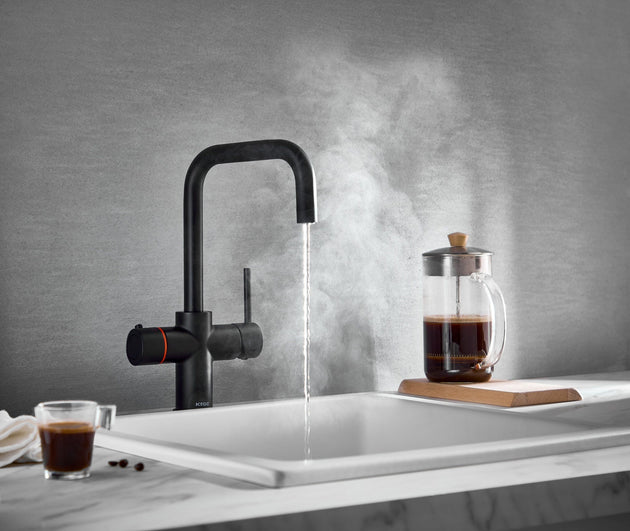

Yes, for most UK households a boiling water tap is worth it. If you make several hot drinks a day, an instant boiling water tap is faster than a kettle, can use up to 50% less energy, frees up worktop space and only heats the water you actually use. The catch has always been the price, with big-name taps costing £1,000 to £3,000. That is the part worth challenging: a complete 3-in-1 boiling water tap kit now starts at £219.99, which changes the maths completely. Below is the honest running-cost breakdown versus a kettle, the safety facts, and how to choose one without overpaying.
In this article
- How does a boiling water tap work?
- Boiling water tap vs kettle: which is cheaper to run?
- So, are boiling water taps worth it?
- Are boiling water taps safe?
- How much does a boiling water tap cost to buy?
- Do you need a filter, and what about maintenance?
- Frequently asked questions
How does a boiling water tap work?
A boiling water tap delivers near-boiling water on demand, usually alongside normal hot and cold water from the same spout, which is why they are often called 3-in-1 taps. A small electric tank sits in the cupboard under your sink, heats water to just below boiling and keeps it there, ready the moment you press the handle. The tank reheats automatically, so it is ready again within minutes.
Most quality taps, including the LavaTap range, deliver water at up to 98°C rather than a full 100°C. That is deliberate. At a true 100°C the water spits and gives off steam, which is less safe and needs a more complex pressurised tank. At 98°C you get a steady, safe stream that is still ideal for tea, coffee, instant noodles and warming pans.

Boiling water tap vs kettle: which is cheaper to run?
Per cup, a boiling water tap is usually cheaper and more efficient than a kettle, because it heats only the water you draw rather than a kettle full. According to the Energy Saving Trust, boiling a full kettle costs around 7p, and most of us overfill. A boiling water tap draws roughly 0.25p to 0.30p for a single mug, uses only about 10 watts to stay hot, and costs around 3p a day on standby. Independent testing suggests a tap can use up to 50% less energy than a kettle for the same drinks.
The more hot drinks your household makes, the faster a tap pays its way. Estimates of the break-even point range from about 7 cups a day (manufacturer figures) to around 23 cups a day (independent calculations), so keen tea and coffee drinkers benefit most.
| Factor | Kettle | Boiling water tap |
|---|---|---|
| Time to hot water | Around 2 to 3 minutes per boil | Instant, no waiting |
| Energy use | Boils more than you need; about 7p per full boil | Heats only what you draw; about 3p a day on standby |
| Water waste | Usually overfilled | Only the amount you use |
| Worktop space | Takes up counter space, plus a cable | Frees the worktop, no cable |
| Upfront cost | £15 to £40 | From £219.99 up to £3,000 |
| When it wears out | Replace the whole kettle | Replace just the filter or the tank |

So, are boiling water taps worth it?
For most households that drink tea or coffee through the day, yes. You save time with no waiting for the kettle, cut energy use, reclaim worktop space and lose the trailing kettle cable. A boiling water tap is especially worth it if you make several hot drinks a day, your kitchen is short on space, or you cook often and want instant hot water for pasta, blanching vegetables and cleaning.
They make less sense if you rarely boil water, or if you cannot have a tank and a switched electrical supply fitted under the sink. The historic downside was always price, but as the next section shows, that objection has largely disappeared.

Are boiling water taps safe, even with children around?
Yes. By law, boiling water taps must have a child-resistant safety mechanism, and good ones go further. The boiling side uses a two-step push-and-turn handle that a child cannot work by accident, and it springs off the moment you let go, so it never pours unattended. The spout stays cool to touch, there is nothing to tip over and no flex cable to pull, which makes a fixed tap arguably safer than a kettle in a busy family kitchen. Running at 98°C rather than a rolling 100°C also means no spitting or steam blast at the spout.
How much does a boiling water tap cost to buy?
Boiling water taps span a wide price range. Premium taps such as Quooker typically cost £1,000 to £3,000, mid-range systems like Qettle run around £500 to £800, and the entry-level market starts near £249 (figures via Which? and Ideal Home). The good news for budget-minded buyers is that you no longer pay premium prices for the core feature.
A complete LavaTap 3-in-1 Swan Neck Kit, which includes the tap, the under-sink tank and the inline filter, is £219.99. That is roughly a fifth of a typical Quooker, and it comes with a lifetime guarantee on the tap and a 5-year guarantee on the boiler.


Tap, 2.4L under-sink tank and inline filter in one box. Hot, cold and near-boiling water from a single tap. Available in chrome, brushed brass or matt black.
Do you need a filter, and what does maintenance involve?
Yes, you should always run an inline filter. Much of the UK has hard water, and limescale is the number one killer of boiling water tanks, furring up the heating element and causing spitting and early failure. An inline scale-inhibiting filter sits between the cold mains and the tank and protects it, while a carbon core also reduces chlorine and improves the taste of your water.
The good news is that the LavaTap 3-in-1 Kit already includes this inline filter, so you are protected from day one. Plan to change the cartridge about every 6 months, or every 4 months in a hard water area (a fresh filter every 6 months also keeps the 5-year tank warranty valid). Beyond that, maintenance is minimal: wipe the tap with a soft cloth and mild soapy water, then rinse and dry it after use.
Frequently asked questions
Do boiling water taps use a lot of electricity?
No. They draw only about 10 watts to stay hot and roughly 3p a day on standby, and most have an eco or night mode. Because they heat only what you use, they can use up to 50% less energy than a kettle.
Do boiling water taps give you true 100°C water?
Most deliver up to 98°C, and that is by design. A non-pressurised 98°C tank is safer, simpler to install and ideal for tea and coffee. Brewing guidance generally recommends slightly below boiling water anyway. True 100°C taps need a more complex pressurised tank.
Can I install a boiling water tap myself?
If you are confident with plumbing it is straightforward, but the tank needs a cold feed, the correct mains pressure (1.5 to 5 bar) and a switched electrical supply. It must also be primed with water before switching on, or you risk damaging the element. Many people use a plumber for peace of mind.
How long do boiling water taps last?
A good tap can last many years, because the tank is the wear part. With a filter fitted and changed on schedule, a quality tank typically lasts around 5 years or more, and you can replace just the tank when it eventually fails.
Are boiling water taps worth it for a small household?
If you still make several hot drinks a day, yes, thanks to the time, energy and space savings. If you only boil water occasionally, a kettle may work out cheaper overall.
Ready to skip the kettle, and the Quooker price tag?
Get a complete 3-in-1 boiling water tap, tank and filter for £219.99.
Shop the LavaTap 3-in-1 Kit →Lifetime guarantee on the tap, 5-year guarantee on the boiler. UK stock, fast dispatch.
Share on
Publication Date
Category
15mm pipe,22mm pipe,barrier pipe,boiling water taps,buying guide,DIY,garden tap,garden tap kit,kitchen taps,outside tap,PEX pipe,plumbing,polybutylene,push fit,water regulations,WRAS
Reading Time
7 Min
Author Name
Lava Wholesale


